RAG vs AI Agents vs Agentic AI: What Business Software Buyers Should Build First
A practical buyer guide explaining when to build RAG, AI agents, or agentic AI workflows inside custom business software, with examples, risks, and a build checklist.
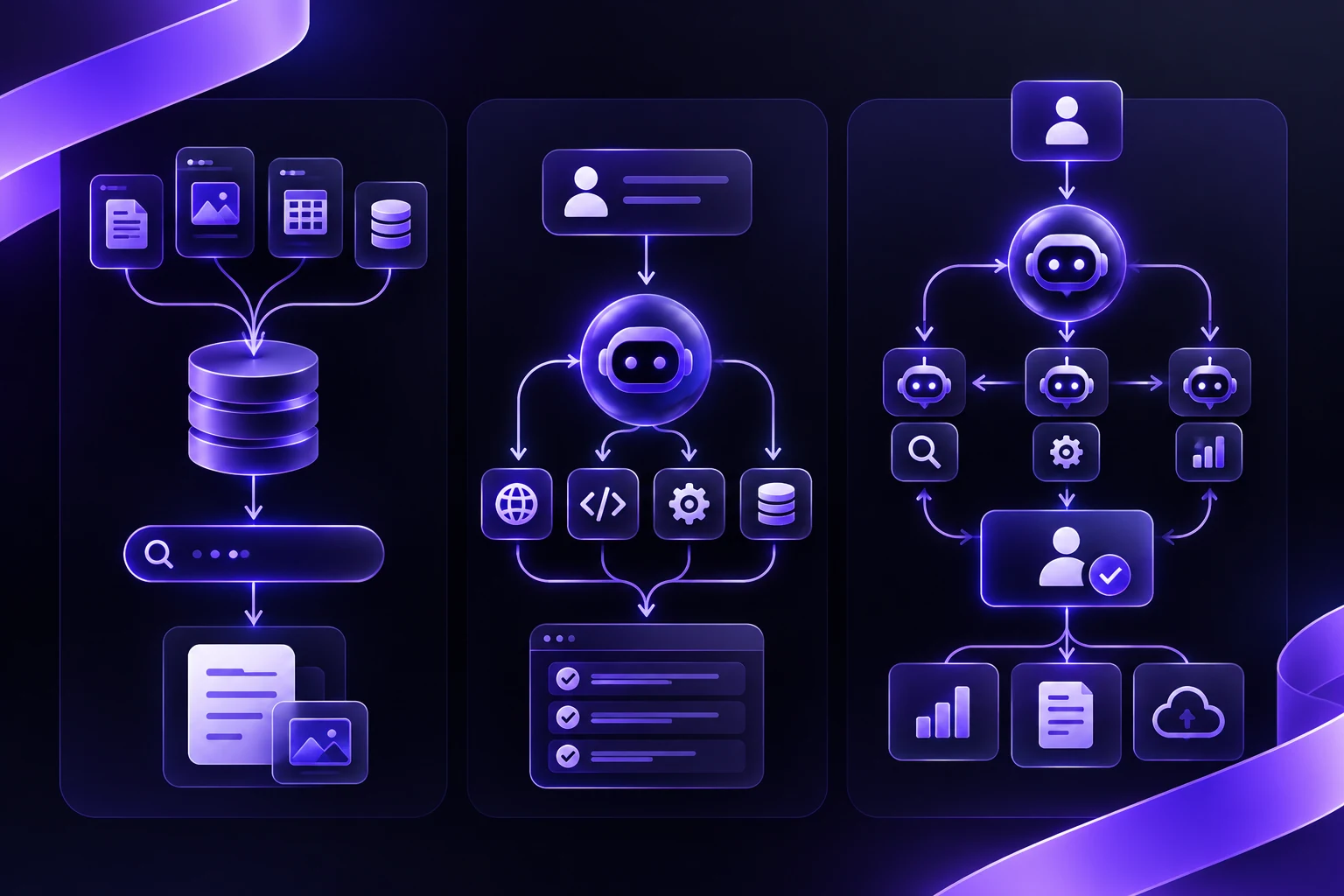
Direct answer: RAG helps an AI system answer with the right knowledge. An AI agent helps an AI system take a bounded action. Agentic AI describes a larger software pattern where one or more agents plan, use tools, check results, and move a workflow forward with some autonomy. Most business software teams should build in that order: start with RAG when the main problem is trusted knowledge, add an agent when the system needs to act, and consider agentic AI only when the workflow has enough value, data quality, permissions, testing, and human oversight to justify the extra risk.
Cost and timeline change depending on whether the first release needs RAG, an AI assistant, a tool-using agent, an agentic workflow, or regular automation. This AI workflow automation cost guide explains the buyer-side tradeoffs.
Once you know whether a first release needs RAG, an AI agent, an agentic workflow, or regular automation, use this AI workflow automation requirements checklist to prepare scope, data, integrations, review, and launch inputs.
After deciding whether the first release should be RAG, an AI agent, or an agentic workflow, buyers can use this AI workflow automation partner checklist to compare delivery teams.
The confusion matters because these are not just labels. They lead to different budgets, timelines, security reviews, integration work, and support models. A company that asks for an "AI agent" when it really needs a grounded knowledge assistant may overbuild. A company that ships an agentic workflow when it has not solved permissions, logging, rollback, and review can create a system that looks impressive in a demo and becomes risky in production.
This guide is written for business and technology buyers comparing custom AI software, internal copilots, workflow automation, and AI-enabled operations tools. It is also a companion to our AI workflow automation company shortlist, custom AI consultant shortlist, and AI development services.
The Short Version
| Need | Best starting point | What it does | Main risk |
|---|---|---|---|
| Answer questions from approved documents, policies, tickets, manuals, or knowledge bases | RAG | Retrieves relevant source material and uses it to ground an answer | Bad retrieval, stale content, weak source permissions, or overconfident answers |
| Help a user complete a narrow task such as classifying a ticket, drafting a reply, creating a summary, or updating one record | AI agent | Uses a model plus tools, memory, rules, and permissions to complete a bounded action | Tool misuse, excessive permissions, missing approvals, or poor failure handling |
| Coordinate a multi-step business process across systems, people, and approvals | Agentic AI workflow | Plans and executes several steps, often with multiple tools or specialized agents | Unclear ownership, hidden errors, runaway autonomy, audit gaps, or fragile orchestration |
The practical rule is simple: use RAG to improve what the AI knows, use agents to define what the AI can do, and use agentic AI only when the software around the AI is mature enough to control the workflow.
What RAG Means In Business Software
RAG stands for retrieval-augmented generation. In plain terms, it connects a large language model to external knowledge before the model answers. Google Cloud describes RAG as combining information retrieval systems, such as search and databases, with LLMs so outputs can be more accurate, current, and relevant. AWS similarly describes RAG as a way for an LLM to reference an authoritative knowledge base outside its training data before generating a response.
For a business, RAG is often the right first release when people are asking questions such as:
- What does our policy say about this customer scenario?
- Which installation manual applies to this equipment model?
- What happened in similar support tickets?
- Which contract clause or internal standard should the team review?
- What does our product documentation say, and where is the source?
A good RAG system is not just a chatbot over documents. It needs source selection, access permissions, chunking, indexing, retrieval testing, citation display, freshness rules, user feedback, and a clear answer policy when the system does not know. Without those pieces, RAG can still produce polished answers from the wrong context.
What An AI Agent Means
An AI agent is software that uses AI to pursue a goal or complete a task on behalf of a user. Google Cloud describes AI agents as systems with reasoning, planning, memory, and some autonomy. In buyer language, the important difference is action: an agent is not only answering. It can use tools, call APIs, inspect records, draft work, route items, or update systems within the permissions it has been given.
That makes agents useful, but it also changes the project. The question is no longer only, "Can the AI produce a good answer?" The question becomes, "What is the AI allowed to do, under which conditions, with what approval, and with what audit trail?"
Good agent use cases are narrow enough to test. Examples include:
- Classifying inbound support tickets and suggesting the next queue.
- Drafting a customer reply from approved knowledge, with a human approving before send.
- Checking a CRM record, identifying missing fields, and creating a suggested update.
- Summarizing a project status thread and creating a draft task list.
- Looking up inventory, checking a rule, and recommending a service appointment time.
The best first agents usually act like careful junior operators inside a limited lane. They should not be given broad write access, financial authority, unrestricted messaging, or unclear escalation rules on day one.
What Agentic AI Means
Agentic AI is the broader pattern: a system that can work toward a goal with limited supervision. IBM describes agentic AI as systems that can accomplish a specific goal with limited supervision, sometimes through multiple agents coordinated by orchestration. In business software, this usually means the AI is part of a workflow, not just a single feature.
For example, an agentic field-service workflow might:
- Read a new service request.
- Retrieve warranty, customer, equipment, and prior ticket context.
- Classify urgency.
- Check technician availability.
- Draft a recommended appointment plan.
- Ask a dispatcher to approve or edit.
- Update the CRM and notify the customer after approval.
- Log what it did and why.
That may be valuable. It is also a real software system with workflow design, integrations, permissions, monitoring, QA, and support. Calling it "agentic AI" does not remove the need for product thinking, security design, or operational ownership.
RAG vs AI Agents vs Agentic AI
| Question | RAG | AI agent | Agentic AI workflow |
|---|---|---|---|
| Primary job | Ground answers in trusted knowledge | Complete a defined task with tools | Coordinate a multi-step process |
| Typical output | Answer, summary, citation, recommendation | Action proposal, drafted work, routed item, API call | Completed workflow state with logs, approvals, and handoffs |
| Core software work | Data source mapping, retrieval, indexing, permissions, evaluation | Tool design, permissions, task boundaries, human review, action logs | Workflow orchestration, retries, monitoring, controls, support model |
| When it fits | The team needs better answers from private or specialized content | The team needs help taking a repeatable action | The team needs coordinated work across tools, people, and rules |
| When to avoid it | Source data is messy, unowned, or permissioned poorly | The task is vague or the action is too risky to automate | The workflow lacks stable rules, observability, or accountable owners |
What Should A Business Build First?
Most companies should start with the smallest useful system that reduces uncertainty. That usually means one of four paths.
Start With RAG When Knowledge Is The Bottleneck
Choose RAG first when employees or customers already know what they want to ask, but the answer is buried across documents, tickets, manuals, policies, product pages, or internal systems. This is often the right starting point for support teams, operations teams, regulated workflows, knowledge bases, onboarding systems, and internal copilots.
The first milestone should not be "the AI answers everything." A better milestone is: the AI answers a defined set of high-value questions, shows sources, respects permissions, and says when it cannot answer safely.
Add An Agent When The AI Needs To Do Something
Move from RAG to an agent when the valuable next step is action. Maybe the system should create a draft quote, classify a lead, update a status, search an inventory system, or prepare a support response. At this point, the agent needs tools and permissions, and the project needs controls.
A good first production agent should have a bounded goal, a small tool set, clear inputs, visible reasoning or logs where appropriate, and a review step before important actions. If the workflow cannot describe the allowed action in plain language, it is not ready for automation.
Use Agentic AI When The Workflow Itself Is The Product
Agentic AI makes sense when the value is in coordinating multiple steps. This may be a claims workflow, support triage workflow, procurement workflow, scheduling workflow, reporting workflow, or internal operations workflow. The AI is not just answering or taking one action. It is helping move work from one state to another.
This is where custom software planning matters most. The team needs to define users, roles, approvals, integrations, fallbacks, audit logs, monitoring, uptime expectations, and support responsibilities before building.
Stay With A Regular Workflow When Rules Are Stable
Not every automation needs generative AI. If the business rule is deterministic, the best answer may be a normal workflow, form, integration, or rules engine. AI belongs where language, judgment, messy input, classification, summarization, retrieval, or exception handling creates value. It should not replace simple software logic just because the word "agent" is fashionable.
Buyer Examples
Example 1: Internal Policy Assistant
A company wants employees to ask HR, compliance, or operations questions and get sourced answers. The best first build is usually RAG. The software needs document ownership, access rules, retrieval evaluation, source citations, and a feedback loop. An agent is unnecessary unless the assistant will also file requests, update records, or trigger workflows.
Example 2: Customer Support Triage
A support team wants to classify tickets, identify priority, suggest an answer, and route work. This can start as RAG for source-backed response suggestions, then become an agent when it begins routing tickets or preparing updates. Human review should stay in place until the team has enough quality data to widen automation.
Example 3: Operations Reporting Workflow
A manager wants weekly reporting that pulls from multiple systems, explains anomalies, drafts commentary, and sends a summary for approval. This is closer to an agentic workflow. The system needs data connectors, schedule rules, exception handling, approval, observability, and a support plan.
Example 4: Field-Service Scheduling
A field-service team wants AI to read requests, inspect customer history, check technician availability, and suggest appointment windows. A narrow agent may be useful for recommending next steps. Full agentic AI should wait until scheduling rules, technician constraints, customer notification rules, and override paths are well defined.
The Build Checklist
Before requesting proposals for RAG, agents, or agentic AI, define these inputs:
- Workflow: What business process is changing?
- User roles: Who asks, approves, edits, overrides, or audits?
- Data sources: Which documents, systems, databases, APIs, or tickets are in scope?
- Permissions: What can each user and AI component read or write?
- Knowledge freshness: Who owns updates, retirement, and source quality?
- Actions: What can the AI do, draft, recommend, submit, or update?
- Human review: Which steps require approval before external or irreversible action?
- Evaluation: Which test questions, edge cases, and bad outputs will be checked before launch?
- Security: How will prompt injection, data leakage, tool misuse, and excessive agency be managed?
- Logging: What should be recorded for debugging, audit, and support?
- Fallbacks: What happens when the system is uncertain, unavailable, or wrong?
- Maintenance: Who supports the model, prompts, retrieval layer, tools, integrations, and UI after launch?
These are the same kinds of inputs that change custom software cost and timeline. If you are still scoping budget, use our software project estimation checklist before asking vendors for a number.
Security And Governance Are Not Optional
RAG, agents, and agentic AI all inherit the usual risks of generative AI, including confabulation, data privacy concerns, and over-reliance. NIST's AI Risk Management Framework and Generative AI Profile are useful references for teams that need a structured way to think about risk. OWASP's 2026 LLM guidance highlights security risks in LLM applications, and OWASP's agentic applications guidance focuses specifically on autonomous systems that plan, act, and make decisions across workflows.
For buyers, this translates into a few practical rules:
- Treat retrieved content, user input, and third-party content as untrusted until validated.
- Do not give an AI component broader permissions than the task requires.
- Keep humans in the loop for irreversible, external, financial, legal, or customer-impacting actions.
- Log tool calls, source usage, approvals, overrides, and failure states.
- Test with real edge cases, not only happy-path demos.
- Plan maintenance for prompts, indexes, tools, permissions, and integrations.
The more autonomy a system has, the more the surrounding software matters. Agentic AI is not just a model selection decision. It is an architecture, operations, security, and support decision.
How To Ask For The Right Proposal
When speaking with a custom software or AI development partner, avoid asking only, "Can you build us an AI agent?" A better request is more specific:
We want to improve this workflow. These users are involved. These data sources are available. These systems may need integration. These actions are allowed. These actions require approval. These risks matter. We need help deciding whether the first release should be RAG, a bounded agent, or an agentic workflow.
That framing gives a vendor enough information to design the right first release. It also helps separate useful AI work from vague AI theatre.
If you are comparing partners, our custom software development company shortlist and AI workflow automation shortlist can help structure the conversation. For a project that needs to become reliable business software, you can also talk with Essential Designs about workflow, data, integrations, QA, launch, and support.
References
- Google Cloud: What is Retrieval-Augmented Generation?
- AWS: What is Retrieval-Augmented Generation?
- Google Cloud: What are AI agents?
- IBM: What is agentic AI?
- NIST AI Risk Management Framework
- OWASP GenAI LLM Top 10 2026
- OWASP Top 10 for Agentic Applications 2026
FAQ
Is RAG an AI agent?
No. RAG is a retrieval pattern that helps an AI system answer from relevant external knowledge. An AI agent may use RAG as one of its tools, but RAG by itself does not make the system an agent.
What is the difference between an AI agent and agentic AI?
An AI agent is usually a software component that can complete a bounded task with some autonomy. Agentic AI is the broader workflow or system pattern where one or more agents plan, use tools, coordinate steps, and move a process forward.
Should a business start with RAG or an AI agent?
Start with RAG when the main problem is getting accurate, sourced answers from private or specialized content. Start with an agent only when the system needs to take a defined action, and the team can specify permissions, review steps, logs, and failure handling.
When does agentic AI make sense?
Agentic AI makes sense when the workflow has enough value to justify multi-step automation and enough operational maturity to control it. Good candidates usually have clear users, stable rules, accessible data, defined approvals, useful integrations, and accountable owners.
Can RAG and AI agents work together?
Yes. Many strong systems combine them. RAG gives the agent grounded knowledge, and the agent uses tools to act on a defined task. The important design decision is where retrieval ends, where action begins, and what a human must approve.
What is the biggest risk with agentic AI?
The biggest practical risk is giving the system too much autonomy or permission before the workflow is ready. Tool misuse, excessive agency, hidden errors, data leakage, and weak auditability can matter more than model quality.